Guerra na ucrânia: putin elogia postura de orbán sobre o conflito
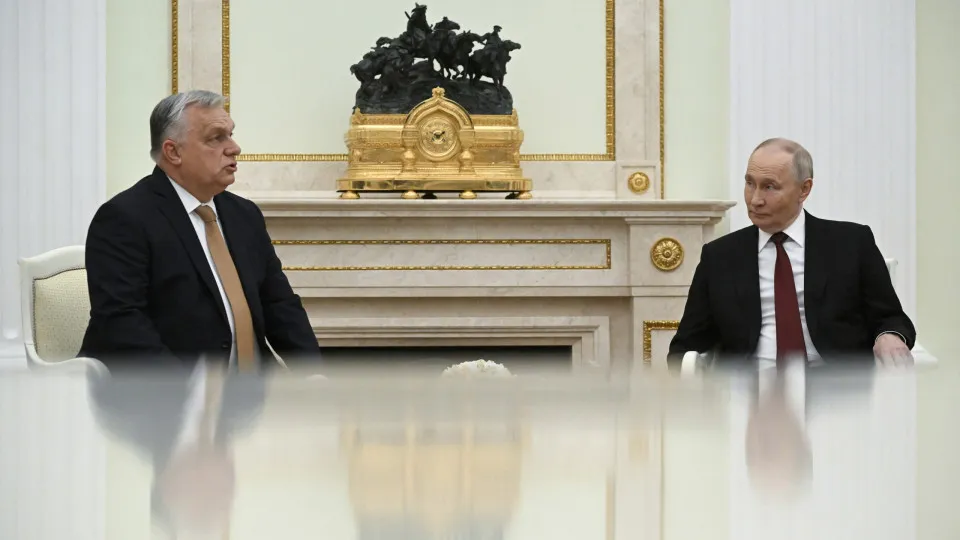
Em um contexto de tensões geopolíticas elevadas, o presidente da Rússia, em declaração recente, destacou o que considera ser uma “posição equilibrada” por parte do primeiro-ministro da Hungria, Viktor Orbán, em relação à situação na Ucrânia. Orbán, conhecido por sua postura crítica em relação às sanções impostas pela União Europeia à Rússia e ao apoio financeiro e militar a Kyiv, tem mantido um diálogo aberto com Moscou, mesmo em meio ao conflito.
A relação entre Hungria e Rússia tem se mantido estável, especialmente no que diz respeito ao fornecimento de energia. Orbán reiterou que a Hungria continuará a importar produtos energéticos da Rússia, apesar das sanções decretadas pela UE em resposta à invasão da Ucrânia em fevereiro de 2022. Segundo o primeiro-ministro húngaro, o abastecimento de energia proveniente da Rússia continua sendo a base do sistema energético da Hungria e assim permanecerá no futuro.
Essa dependência energética coloca a Hungria em uma posição delicada dentro da UE, já que o bloco tem buscado reduzir sua dependência de combustíveis fósseis russos como forma de pressionar Moscou aFind the number of real solutions to
[(x^2 + 2x + 3)^2 + 4(x^2 + 2x + 3) – 5 = 0.]
Let $y = x^2 + 2x + 3$. Then the equation becomes
begin{align} y^2 + 4y – 5 &= 0 (y + 5)(y – 1) &= 0 end{align}
So $y = -5$ or $y = 1$.
If $y = -5$, then $x^2 + 2x + 3 = -5$, so $x^2 + 2x + 8 = 0$. The discriminant is $2^2 – 4(1)(8) = 4 – 32 = -28$, which is negative. Therefore, there are no real roots in this case.
If $y = 1$, then $x^2 + 2x + 3 = 1$, so $x^2 + 2x + 2 = 0$. The discriminant is $2^2 – 4(1)(2) = 4 – 8 = -4$, which is negative. Therefore, there are no real roots in this case.
Therefore, there are no real solutions to $(x^2 + 2x + 3)^2 + 4(x^2 + 2x + 3) – 5 = 0.$
Let $u = x^2 + 2x + 3 = (x + 1)^2 + 2.$ Since $(x + 1)^2 ge 0$ for all real numbers $x,$ $u ge 2.$
The equation $(x^2 + 2x + 3)^2 + 4(x^2 + 2x + 3) – 5 = 0$ becomes
begin{align} u^2 + 4u – 5 &= 0 (u – 1)(u + 5) &= 0 end{align}
Thus, $u = 1$ or $u = -5.$ However, since $u ge 2,$ we must have $u = 1$ or $u = -5.$ Since we require $u ge 2,$ there are no real solutions.
We have $x^2 + 2x + 3 = (x + 1)^2 + 2.$ Then we want to solve
begin{align} (x^2 + 2x + 3)^2 + 4(x^2 + 2x + 3) – 5 &= 0 ((x + 1)^2 + 2)^2 + 4((x + 1)^2 + 2) – 5 &= 0 end{align}Let $u = (x + 1)^2.$ Then $u ge 0,$ and the equation becomes
begin{align} (u + 2)^2 + 4(u + 2) – 5 &= 0 u^2 + 4u + 4 + 4u + 8 – 5 &= 0 u^2 + 8u + 7 &= 0 (u + 1)(u + 7) &= 0 end{align}Thus, $u = -1$ or $u = -7.$ Since $u ge 0,$ there are no possible values for $u.$ Therefore, there are no real solutions.
Final Answer: The final answer is $boxed{0}$
Fonte: www.noticiasaominuto.com